What to See at Delphi
The Sacred Way, the Temple of Apollo, the theatre, the stadium and the museum's Charioteer: what happened at Delphi and what to look for, in walking order.
Delphi is the sanctuary of Apollo on the southern slope of Mount Parnassus in central Greece, about 180 km north-west of Athens. For more than a thousand years Greeks came here to consult the oracle: a priestess, the Pythia, spoke for Apollo in his temple, and her answers shaped wars, colonies and laws. What survives is a hillside of monuments you climb in order, and a museum of what was found there. This is the order to see them in.
The story in one paragraph
The Greeks believed Zeus released two eagles from opposite ends of the earth and that they met here, which made Delphi the centre of the world; a carved stone, the omphalos or navel, marked the spot. Apollo was said to have killed the serpent Python here and taken over the site. Cities and rulers sent questions to the oracle and thanked the god with gifts, which is why the hillside is crowded with treasuries and monuments. Every four years the Pythian Games were held here, with music, poetry and athletic contests. The sanctuary declined under Rome and closed in the late fourth century AD. French archaeologists uncovered it from the 1890s, and it has been a UNESCO World Heritage Site since 1987.
The walk up the hill
1. The Sacred Way. From the entrance a stone path zigzags up the slope. It was lined with offerings from the Greek cities, each trying to outdo the others, and their bases are still everywhere.
2. The Treasury of the Athenians. The small marble building most photographs of Delphi show. The Athenians built it in the early fifth century BC; French archaeologists put it back together from its original blocks between 1903 and 1906.
3. The Temple of Apollo. The heart of the sanctuary, on its great terrace held up by a wall of interlocking polygonal stones (look at the wall: it is covered with inscriptions, many of them records of freed slaves). The temple you see is the fourth-century BC rebuilding; a few columns have been set back up. Inside it, the Pythia gave the oracle.
4. The theatre. Above the temple, with seats for about 5,000 people and the best view on the site, down over the temple to the valley of olive trees.
5. The stadium. A further steep climb above the theatre, one of the best-preserved ancient stadiums in Greece, where the Pythian Games’ races were run. It is the part most day visitors miss for lack of time. If it matters to you, go up first and come down to meet the group.
A hillside of foundations is hard to read alone, and this is where a guide earns the fee. TAG Athens' Delphi day keeps a licensed guide with you inside the site and the museum, from $40 per person in current promotion (usually $66), rated 4.8 from 2,629 reviews (checked October 2026); the tickets are an option at booking. The tour does not currently go to the Sanctuary of Athena Pronaia, for safety reasons.
Below the road: Athena Pronaia and the spring
The Castalian Spring, between the two sanctuaries, is where pilgrims purified themselves before consulting the oracle.
The Sanctuary of Athena Pronaia, a short walk east and below the main road, holds the Tholos, the round fourth-century BC building whose three standing columns are the other famous image of Delphi. Not every tour goes there, so check the itinerary if you want to see it close up, or walk down on your own if you have time.
Can't Make These Dates?
Browse More Available Options
Find a tour that fits your schedule. Dates and cancellation terms are on each listing.
The museum
Allow an hour. It is air-conditioned and flat, which is welcome after the hill. The pieces not to miss:
- The Charioteer. A life-size bronze of a young chariot driver, made to celebrate a victory in the Pythian Games around 478 to 470 BC and dedicated by Polyzalos, a ruler in Sicily. It is one of the finest Greek bronzes to survive, and the eyes, inlaid in glass and stone, are still in place.
- The Sphinx of the Naxians. A winged lion with a woman’s head, offered by the island of Naxos around 560 BC. It stood on top of an Ionic column about 10 metres high next to the temple.
- The Siphnian Treasury frieze. Carved scenes of gods and giants at war, from the treasury of the island of Siphnos, with traces of their original colour.
- Kleobis and Biton. Two archaic marble youths, among the oldest large statues from the site.
- The statue of Antinous, the Roman emperor Hadrian’s companion, a reminder that Delphi was still visited in Roman times.
Seeing it on a day trip
The guided day trips from Athens give about an hour and three quarters at the site and an hour in the museum, which is enough for the walk up to the theatre and the main rooms of the museum. The homepage compares the main days, and the opening hours guide has the ticket details. If you want the stadium, Athena Pronaia and the museum at an easy pace, drive or stay the night: how to get from Athens to Delphi covers that.
Written 25 October 2026. The Naxian Sphinx date and column height are from the Ephorate’s Delphi site (delphi.culture.gr); the Treasury restoration (1903 to 1906) and the Charioteer’s dedication and date are standard references for the site. The theatre’s capacity and the tour’s itinerary come from the tour listings. Tour prices and ratings come from the GetYourGuide listing, read 25 October 2026.
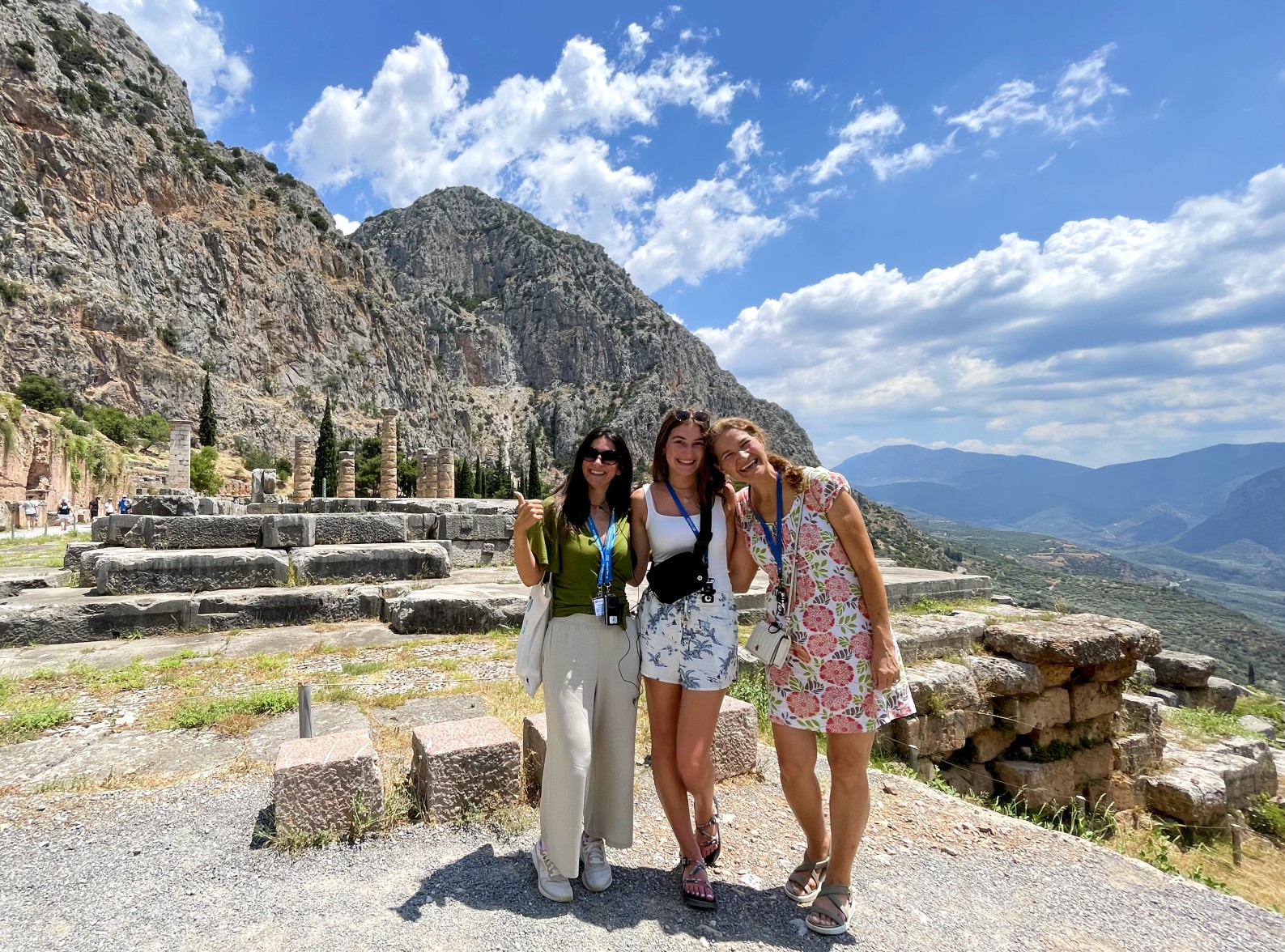
The Site with a Licensed Guide
TAG Athens' Delphi day keeps a licensed guide with you at the site and in the museum, then stops at a mountainside taverna before the drive back to Athens.
Check Availability & Book